Deep Cleaning vs. Standard Cleaning: What's Included
A room-by-room breakdown of what belongs in a standard clean versus a deep clean, how to scope and price the difference, and when to recommend a deep clean first.
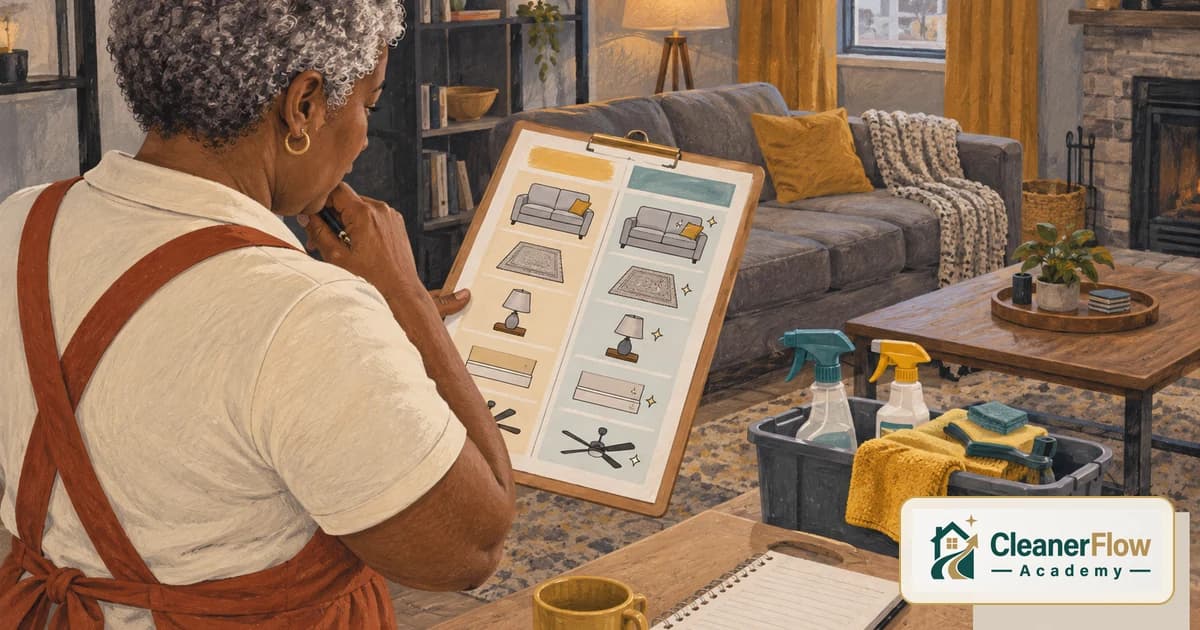
The difference clients almost never understand
Most misunderstandings between a house cleaner and a client come down to one question: what exactly did the price cover? A client hears "cleaning" and pictures a spotless home from top to bottom. The cleaner hears "standard clean" and plans to maintain a home that is already in reasonable shape. When those two pictures do not match, someone ends up disappointed, and it is usually the person holding the mop.
Understanding the line between a standard clean and a deep clean is one of the most valuable skills a professional cleaner can have. It protects your time, it protects your body, and it lets you quote work honestly. This article walks through both services room by room, explains how long each realistically takes, and shows you how to scope and price the difference without guesswork.
What a standard clean actually is
A standard clean, sometimes called a recurring or maintenance clean, keeps a home that is already in good condition looking and feeling clean. It assumes the home is cleaned on a regular schedule, whether weekly, every two weeks, or monthly. The work is about surfaces you touch and see every day.
Standard clean, room by room
- Kitchen: wipe countertops and the outside of appliances, clean the stovetop surface, wipe the outside of the microwave and inside if quick, clean the sink, spot-clean cabinet fronts, empty the trash, sweep and mop the floor.
- Bathrooms: clean and disinfect the toilet, sink, and counter, clean the mirror, wipe the outside of the shower and tub, wipe visible surfaces, empty the trash, sweep and mop.
- Bedrooms and living areas: dust reachable surfaces, tidy visible clutter, make beds if requested, vacuum carpets, sweep and mop hard floors.
- Whole home: empty trash bins, dust reachable surfaces and furniture, wipe light switches and door handles, vacuum and mop throughout.
The defining trait of a standard clean is that it addresses what has accumulated since the last visit. It does not reach into places that only need attention a few times a year.
What a deep clean adds
A deep clean is not a standard clean done more carefully. It is a different scope of work that reaches the built-up grime a standard clean intentionally skips. It targets areas that are hard to reach, time consuming, or only dirty after months of use. A deep clean is what you perform on a first visit to a new client, after a long gap in service, before or after a season, or when a home has simply fallen behind.
Deep clean, room by room
- Kitchen: clean inside the oven, clean inside and behind the refrigerator where reachable, degrease the range hood and filter, wipe inside cabinets and drawers if requested, scrub grout, descale the sink and faucet, clean backsplash thoroughly, clean small appliances.
- Bathrooms: scrub grout and tile, remove soap scum and hard water buildup from glass and fixtures, descale the showerhead, clean behind and around the toilet base, wash the exhaust fan cover, detail the tracks of shower doors.
- Bedrooms and living areas: dust and wipe baseboards, clean window sills and interior window glass, dust ceiling fans and light fixtures, wipe doors and door frames, vacuum under furniture and cushions, clean vents and air return covers.
- Whole home: hand-wipe baseboards throughout, clean switch plates and outlet covers, remove cobwebs from corners and ceilings, detail door frames and trim, wash reachable interior windows, clean behind and under movable furniture and appliances.
The defining trait of a deep clean is that it resets the home. After a proper deep clean, standard cleans can maintain that level with far less effort.
How long each one takes
Time is where scoping mistakes turn into lost money, so it helps to keep realistic ranges in mind.
A standard clean on an average single-family home of three bedrooms and two bathrooms usually runs somewhere between two and three hours for one experienced cleaner. Smaller apartments can be done in an hour to ninety minutes. These times assume the home is already maintained.
A deep clean on that same three-bedroom, two-bath home commonly takes four to seven hours for one cleaner, and sometimes more if the home has heavy buildup, pet hair, or has not been professionally cleaned in a long time. As a working rule, a first-time deep clean often takes roughly two to three times as long as the recurring clean that follows it. That multiple is the single most important number to internalize, because it is exactly what clients underestimate.
How to scope and quote the difference
Scoping is the process of deciding what work a job actually requires before you name a price. Never quote a deep clean sight unseen if you can avoid it. A walkthrough, whether in person or through clear photos and questions, protects you from taking a fixed price on a job that turns out to be twice the work.
Questions that reveal the true scope
- When was the home last cleaned professionally, and how often is it cleaned now?
- Are there pets, and if so how many and what kind?
- Are there specific problem areas, such as an oven that has not been cleaned in a year or a shower with heavy buildup?
- Is anyone in the home a smoker?
- Are there tasks the client assumes are included that you would treat as add-ons, such as inside the refrigerator, interior windows, or wall washing?
Pricing the two services differently
A deep clean should always cost more than a standard clean because it takes more time, more product, and more physical effort. There are two common honest approaches. The first is to charge by the hour for deep cleans, which protects you when a home is far worse than expected. The second is to quote a flat deep-clean rate that reflects your realistic time estimate, then move the client onto a lower recurring rate once the home is reset.
Whatever model you choose, put the scope in writing before you start. List what is included and, just as importantly, what is not. A short written scope prevents the most common conflict in this trade, which is the client who expected a deep clean while paying for a standard one.
When to recommend a deep clean first
One of the marks of a professional is knowing when to say that a standard clean is not the right starting point. Recommending a deep clean first is not upselling when the home genuinely needs it. It is honest scoping, and it protects both parties.
Recommend a deep clean first when:
- The home has never been professionally cleaned, or not for many months.
- There is visible buildup on baseboards, in bathroom grout, or on kitchen surfaces.
- The client is starting recurring service and wants it to look its best.
- The home is being prepared for guests, a sale, or a special event.
Explain it plainly. Tell the client that a standard clean maintains a home that is already clean, and that starting from a reset lets every future visit go faster and cost less. Most clients accept this readily when it is framed as care rather than a sale.
Common scoping mistakes cleaners make
Experience is often just a collection of mistakes you have already made. Here are the ones worth avoiding early.
- Quoting a deep clean at a standard-clean price. This is the most expensive mistake in the trade. It comes from underestimating the two-to-three-times time multiple.
- Not doing a walkthrough. Committing to a flat price without seeing the home leaves you exposed on exactly the jobs that are worst.
- Leaving the scope verbal. Memory is not a contract. Write down what is included.
- Treating add-ons as free. Inside the oven, inside the refrigerator, interior windows, and wall washing are real time. Price them as line items.
- Promising a deep-clean result within a standard-clean window. You cannot reset a neglected home in two hours. Say so before you start, not after.
Safety belongs in the scope
Deep cleaning involves stronger products, more physical reach, and longer exposure, so safety is part of professional scoping rather than an afterthought.
- Never mix cleaning products, especially anything containing bleach with anything containing ammonia. The combination releases dangerous gas.
- Ventilate when using degreasers, oven cleaners, and bathroom products. Open a window or run a fan.
- Wear gloves for prolonged contact with strong products, and consider eye protection when cleaning overhead.
- Use a stable step stool for high work. Do not stand on furniture.
- Protect your back by bending at the knees and taking breaks during long deep cleans.
- Read product labels and respect dwell times. Many products work better when left to sit than when scrubbed immediately.
Bringing it together
The line between a standard clean and a deep clean is not complicated once you name it clearly. A standard clean maintains what is already in good shape and focuses on everyday surfaces. A deep clean resets the home, reaching the buildup that only accumulates over months. The deep clean takes roughly two to three times as long, costs more, and should be scoped in writing after a walkthrough.
Clients rarely understand this line on their own, so a professional who explains it kindly and prices it honestly stands apart. Knowing exactly what belongs in each service, and being able to say so with confidence, is the kind of practical skill that a CleanerFlow Academy certification is meant to recognize in cleaners who already do the work well.
You already clean well. Now you can prove it.
The 7 modules are free. The certificate, with a QR your client checks on the spot, proves what you already know how to do.
Other CleanerFlow apps
Your whole week in one place.
Homes, notes for every client, and who already paid, on your phone — even offline.
Cleaning jobs in your ZIP. See the quality score before you pay.
Every lead goes to 3 cleaners at most, and you get 14 days to dispute a dud.