
How to Write a Simple Cleaning Agreement
A clear one-page agreement protects you and your client, prevents misunderstandings, and makes you look like the professional you already are. Here is how to write one in plain language.
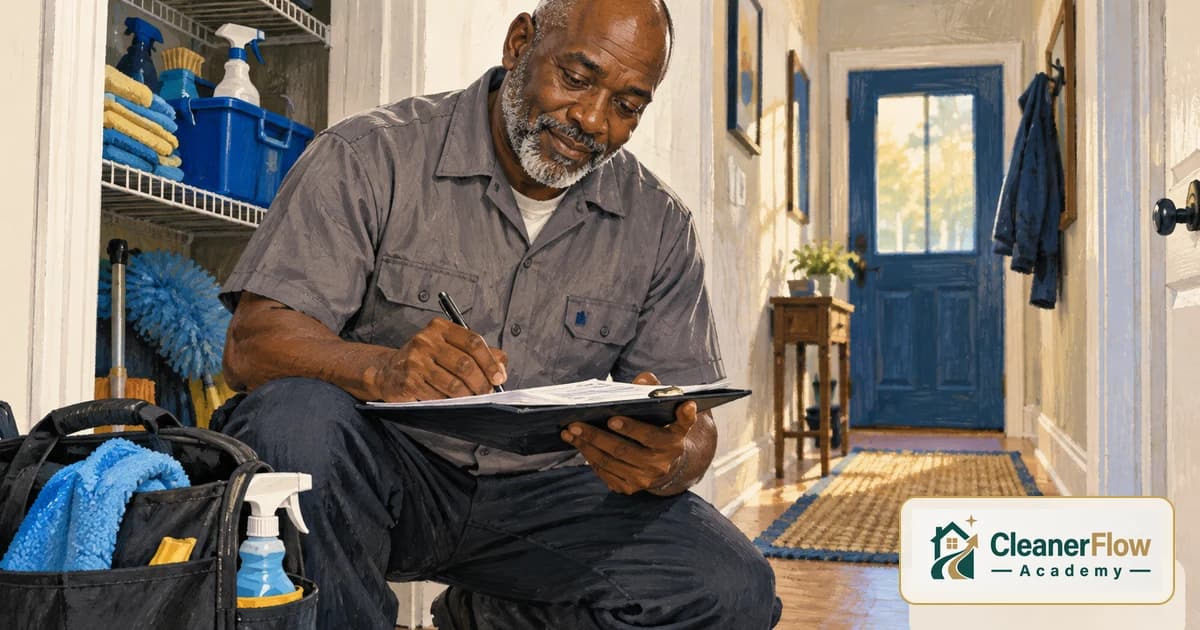
Why a written agreement matters
You already know how to clean a home well. That skill is real, and it is yours. What a written agreement does is give that skill a professional frame. It tells the client exactly what they are paying for, what they can expect, and what happens if plans change. Most disagreements between cleaners and clients do not come from bad work. They come from two people who each assumed something different and never wrote it down.
A simple agreement is not a wall of legal language. It is a short, plain document that both of you can read in two minutes and both of you can sign. When you hand a client a clear one-page agreement, you are quietly telling them something important: you take your work seriously, and you expect to be treated seriously in return.
This is exactly the kind of professionalism that the CleanerFlow Academy certification is built to recognize. The certification validates the skill you already have, rather than teaching you to clean. A clean, confident agreement is one of the ways you show the world that you are a professional, not a favor.
What a simple agreement should include
You do not need a lawyer to write a basic cleaning agreement. You need clear answers to a handful of everyday questions. Cover these, and you will avoid almost every common misunderstanding.
Who the agreement is between
Start with the basics. Your name or business name. The client's name. The address where the work will happen. A phone number or email for each of you. This sounds obvious, but writing it down turns a casual arrangement into a real working relationship. If you ever need to refer back to who agreed to what, this is where it starts.
What is included in the cleaning
This is the most important section, and the one people most often skip. Describe what a standard visit covers, room by room if that helps. For example: kitchen counters, stovetop, sink, and floor; bathrooms including toilet, shower, mirror, and floor; dusting of reachable surfaces; vacuuming and mopping of common areas. Then, just as importantly, list what is not included unless agreed separately. Inside the oven, inside the refrigerator, windows, laundry, dishes, and moving heavy furniture are common examples.
Think of this as drawing a clear line around the job. When the client can see the boundary clearly, they stop expecting extra work for free, and you stop feeling taken advantage of. Everybody relaxes. If a client later wants something on the "not included" list, that is a normal conversation about an extra charge, not an argument.
When and how often
Write down the schedule. Is this a one-time deep clean, a weekly visit, every two weeks, or once a month? What time do you usually arrive, and roughly how long does a visit take? If the client needs to give you access with a key, a code, or by being home, note that too. A recurring client and a one-time client are very different arrangements, and the page should make clear which one this is.
How much and how you are paid
State the price for each visit in plain numbers. Say whether it is per visit or per hour. Explain when payment is due, for example on the day of the cleaning, and which payment methods you accept, whether that is cash, transfer, or an app. If you charge differently for a first deep clean versus regular upkeep, write both prices. Money is the area where silence causes the most tension, so be direct and calm about it. A client who knows the exact number in advance never feels surprised, and you never have to chase an awkward conversation after the work is done.
What happens if plans change
Life happens. Cars break down, children get sick, clients travel. Your agreement should say what happens when either side needs to cancel or reschedule. A common and fair approach is to ask for at least twenty-four hours notice for a cancellation, and to explain any fee if the client cancels with less notice than that. Keep the tone respectful. You are not punishing anyone. You are protecting a day of your income that you cannot easily fill at the last minute. It is also fair to say what you will do if you ever have to cancel, so the client sees the rule works both ways.
Supplies and equipment
Be clear about who provides what. Do you bring your own products and vacuum, or does the client want you to use theirs? If the client prefers specific products, for safety or scent, note it. This is also a good place for a short safety line: you never mix cleaning chemicals, because some combinations can create dangerous fumes. That single sentence signals real professional knowledge and protects everyone in the home.
Trust and care in the home
A short paragraph about care goes a long way. You will treat the home and belongings with respect. If something is accidentally damaged, you will tell the client right away rather than hide it. In return, ask that valuables and cash be put away, so neither of you is ever in an uncomfortable position. This protects your reputation as much as it protects the client, and it prevents the single most painful kind of misunderstanding before it can ever start.
Putting it together on one page
You do not need a fancy template. A single page with each of the sections above as a short heading, followed by one or two plain sentences, is enough. Write the client's answers in as you talk them through it, so the finished page reflects the real conversation you had. When it fits on one page in your own words, a client can read the whole thing in the time it takes to pour a coffee, and that is exactly the point.
Keep the language plain
You do not need words like heretofore or the party of the first part. Plain language is not less professional. It is more professional, because it removes confusion. Write the way you speak, in short sentences. If a client has to ask you what a line means, rewrite that line.
Here is the tone to aim for: calm, clear, and friendly, but specific. Instead of writing the client shall provide adequate notice, write please let me know at least one day ahead if you need to cancel. Both say the same thing. Only one sounds like a real person. The plainer version is also the one a client will actually remember and follow.
How to bring it up without making it awkward
Handing someone a document can feel heavy if you do it the wrong way, so keep it light. Introduce it as something you do for every client, not as a reaction to this particular person. You might say you like to write down what is included so nothing gets lost, and that it protects them as much as it protects you. Offer to read through it together in a minute rather than leaving them to study it alone. Most clients are quietly relieved, because it answers questions they were too polite to ask out loud. If a client hesitates at one line, treat that as useful information: talk it through on the spot and adjust the wording, rather than glossing over it and leaving a small doubt to grow.
Making it official without making it complicated
Once your agreement is written, you and the client both sign and date it. Two copies, one for each of you, or a photo of the signed page on both phones. That is enough for a working relationship between a cleaner and a household. You are not filing anything with the government, and this is not a government license or an official document. It is a private understanding between two people who want the same thing: good work, fair pay, and no surprises.
Keep a simple folder, digital or paper, with an agreement for each regular client. When you take on your tenth or twentieth client, you will be grateful that everything is written down instead of living in your memory.
A quick example of how it helps
Imagine a client asks you, three weeks in, to also clean inside the refrigerator every visit. Without an agreement, you either do it for free and feel resentful, or you say no and feel awkward. With an agreement, you simply point to the page: refrigerator interior was on the "not included" list, and you are glad to add it for a small extra charge. The conversation stays friendly because the document, not you, sets the boundary. That is the quiet power of writing things down. It turns tense moments into ordinary business.
Revisiting the agreement over time
An agreement is not frozen forever. After six months, your costs may rise, or the client may add a room, or you may realize a job takes longer than you expected. When that happens, talk about it openly and update the document. A short, honest conversation about price is far easier when there is already a written starting point to adjust from. Clients respect a professional who plans ahead more than one who springs a surprise. Date the new version so you both know which one is current.
Why this makes you more than a cleaner
When you work with clear agreements, you stop being someone who just shows up and start being someone who runs a small business. That shift changes how clients treat you, how you feel about your day, and how much you can earn over time. It also makes it far easier to grow, because organized cleaners can take on more clients without losing track of who expects what.
Good habits like this connect to a bigger picture. A professional who writes clear agreements is usually the same professional who keeps a tidy schedule, keeps their word, and builds a steady stream of clients over the years. CleanerFlow is building an ecosystem to support cleaners in exactly those areas, from staying organized to finding steady work, so that the skill you already have can carry you as far as you want to go.
Get certified
A written agreement is proof of professionalism in one home. The CleanerFlow Academy certification is proof of your professionalism you can carry to every home. It is free, it is available in English, Portuguese, and Spanish, and it validates the real skill you already bring to every home you clean. It is a private certificate, not a government license and not a guarantee of clients or income, but it is honest, verifiable proof that you take the profession seriously. When a new client is deciding whether to trust you, a certification plus a clean, confident agreement is a powerful combination.
Write your simple agreement this week. Then get certified and let the world see the professional you have always been.
You already clean well. Now you can prove it.
The 7 modules are free. The certificate, with a QR your client checks on the spot, proves what you already know how to do.
Other CleanerFlow apps
Your whole week in one place.
Homes, notes for every client, and who already paid, on your phone — even offline.
Cleaning jobs in your ZIP. See the quality score before you pay.
Every lead goes to 3 cleaners at most, and you get 14 days to dispute a dud.