Certified vs. Uncertified Cleaner: What Actually Changes
Two cleaners can do identical work, yet one is chosen and paid more. Here is an honest look at what a certification changes, and just as importantly, what it does not.
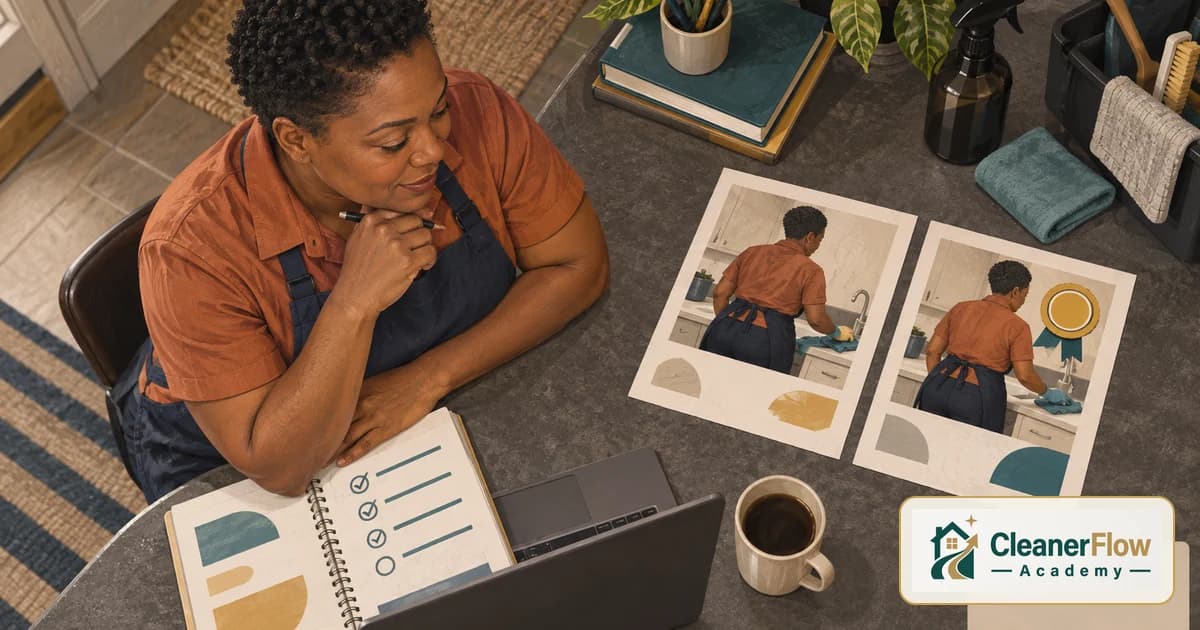
The same hands, a different outcome
Picture two experienced house cleaners. They have similar years behind them, they do work of similar quality, and they charge similar rates. One is certified and one is not. On the surface, nothing separates them. And yet, over time, their careers often look very different. The certified cleaner tends to get chosen more often by cautious clients, holds recurring work more easily, and finds it simpler to raise rates without losing everyone. The uncertified cleaner, doing identical work, has to earn every bit of that trust from scratch, every time.
This is worth understanding honestly, without exaggeration in either direction. A certification is not a magic wand, and it does not make a poor cleaner into a good one. But it does change several real things about how you are seen, chosen, and paid. This article looks plainly at what actually changes, and at what stays exactly the same.
What does not change: the work itself
Let us start with honesty, because it matters. A certification does not make you clean better. If you are already a skilled, experienced cleaner, your hands know things no certificate taught them. You know how to move through a home efficiently, how to protect the surfaces that matter, how to leave a bathroom spotless. A credential does not add to that skill, and it would be dishonest to pretend it does.
This is an important point, because it sets expectations correctly. A certification is not training you to do the job. You already do the job. What it does is entirely about how that existing skill is seen by others. So if you are wondering whether a certificate will make you a better cleaner, the honest answer is no. The right question is whether it will help the good cleaner you already are be recognized, chosen, and paid as one. That is where the real changes happen.
What changes first: how a stranger sees you
The biggest change a certification makes is at the exact moment a new client, who has never met you, is deciding whether to trust you. An uncertified cleaner arrives at that moment with only their word. A certified cleaner arrives with their word plus something a stranger can verify.
This matters because trust is the real currency of home cleaning. A client is letting someone into their private space, often when they are away. Every uncertified cleaner, no matter how skilled, faces the same silent doubt in a new client's mind: I do not really know this person. A certification does not erase that doubt entirely, but it softens it in a way words alone cannot, because it comes from outside you. It says a recognized standard has confirmed you, which is different from you simply claiming to be good.
The practical effect is that certified cleaners often get past the first hurdle faster. They get the call, the trial, the chance to prove themselves, in situations where an uncertified cleaner with identical skill might have been passed over by a nervous client who chose the safer-seeming option. You cannot win a client you never get to meet, and the credential helps you get in the door.
What changes next: which clients you attract
There is a subtler change that experienced cleaners notice over time. The clients who care about certification tend to be a particular kind of client, and often a better one to work with.
A client who looks for a certified cleaner is usually someone who takes the decision seriously, who values professionalism, and who is willing to pay a fair rate for peace of mind. They are less likely to be the client who haggles endlessly, cancels carelessly, or treats you as disposable. By presenting yourself as a credentialed professional, you naturally attract more of these clients and fewer of the ones who are only shopping for the lowest possible price. Over a career, the quality of your clients shapes the quality of your working life as much as the quality of your work does.
This does not mean uncertified cleaners cannot find good clients. Many do, through referrals and reputation built patiently over years. But the certification acts as a kind of filter, quietly drawing the clients who value what you offer and gently sorting out the ones who never would.
What changes over time: your ability to charge fairly
One of the most practical differences shows up in pricing. Raising your rates is one of the hardest things a cleaner does, because it always carries the risk of losing clients. Anything that makes a client feel your rate is justified makes that easier, and a certification is one of those things.
When a certified cleaner sets a rate slightly above the cheapest option, the credential gives the client a reason to accept it. They are not just paying more, they are paying for a professional whose standards have been confirmed. This does not let you charge any amount you like, and it does not override poor service. But at the margin, in the space between the lowest bidder and the fair professional rate, a certification helps you hold the higher, fairer number. Over years, the difference between charging fairly and charging at the bottom adds up to a great deal.
The uncertified cleaner can absolutely reach the same rates, but they usually have to do it purely on the strength of a long personal track record, which takes more time to build and is harder to prove to someone new. The credential is a shortcut to being taken seriously on price, especially before you have years of local references.
What does not change: you still have to earn it every day
Here is the other side of the honest picture. A certification opens doors, but it keeps none of them open on its own. Once a client hires you, the certificate stops doing the work and you start. If a certified cleaner is unreliable, careless, or difficult, the credential will not save them. The client sees the real work now, and the real work is all that matters going forward.
This is actually reassuring, because it means the certification never replaces the thing you are genuinely good at. It gets you the chance, and then your actual skill and reliability take over. A certified cleaner who does poor work will lose clients just as fast as anyone. A certified cleaner who does excellent work turns the door the credential opened into a long, loyal relationship. The certificate and the daily quality are partners, and neither does the other's job.
It is worth saying plainly, too, that a certification like the one from CleanerFlow Academy is a private, professional credential, not a government license. It confirms your standards to clients; it does not grant legal permissions or replace any requirement the law places on your work. Understanding exactly what it is keeps your own claims honest, and honesty is itself part of what makes you trustworthy.
The quieter change: your own confidence
There is one more change worth naming, and it is easy to overlook because it happens inside you rather than in the client's mind. Holding a credential that confirms your standards tends to change how you carry yourself. You quote your rate a little more firmly. You describe your work without apology. You walk into a first meeting feeling like a professional presenting a service, rather than someone hoping to be chosen.
This matters more than it sounds, because clients read confidence. A cleaner who states their price plainly and describes their standards calmly is easier to trust than one who seems unsure of their own worth. The certificate does not create your competence, which was always there, but it can give you permission to stand behind it fully. For many experienced cleaners who have quietly undercharged and undersold themselves for years, that shift in self-regard turns out to be as valuable as anything the client sees. Being good at the work and believing you are good at it are not the same thing, and the second one changes how the first is received.
Weighing it for yourself
So what actually changes when a cleaner becomes certified? Not the quality of the cleaning, which was already yours. What changes is recognition. A stranger trusts you sooner. Better clients find you more easily. Fair rates become easier to hold. And the first hurdle, the one where a nervous client decides whether to give you a chance at all, gets lower.
What does not change is that the work is still yours to do, every single day, to the standard that keeps clients coming back. A certification is not a substitute for being good. It is a way of making sure that being good is not a secret. For a skilled cleaner whose only disadvantage is that new clients cannot see their skill yet, that is not a small thing. It can be the difference between a career spent proving yourself over and over, and one where your reputation, backed by a credential, finally starts working for you.
You already clean well. Now you can prove it.
The 7 modules are free. The certificate, with a QR your client checks on the spot, proves what you already know how to do.
Other CleanerFlow apps
Your whole week in one place.
Homes, notes for every client, and who already paid, on your phone — even offline.
Cleaning jobs in your ZIP. See the quality score before you pay.
Every lead goes to 3 cleaners at most, and you get 14 days to dispute a dud.