How Clients Decide if a Cleaner Is Trustworthy
Before a client ever sees your work, they have already decided how much they trust you. Understanding the quiet signals they read lets you send the right ones on purpose.
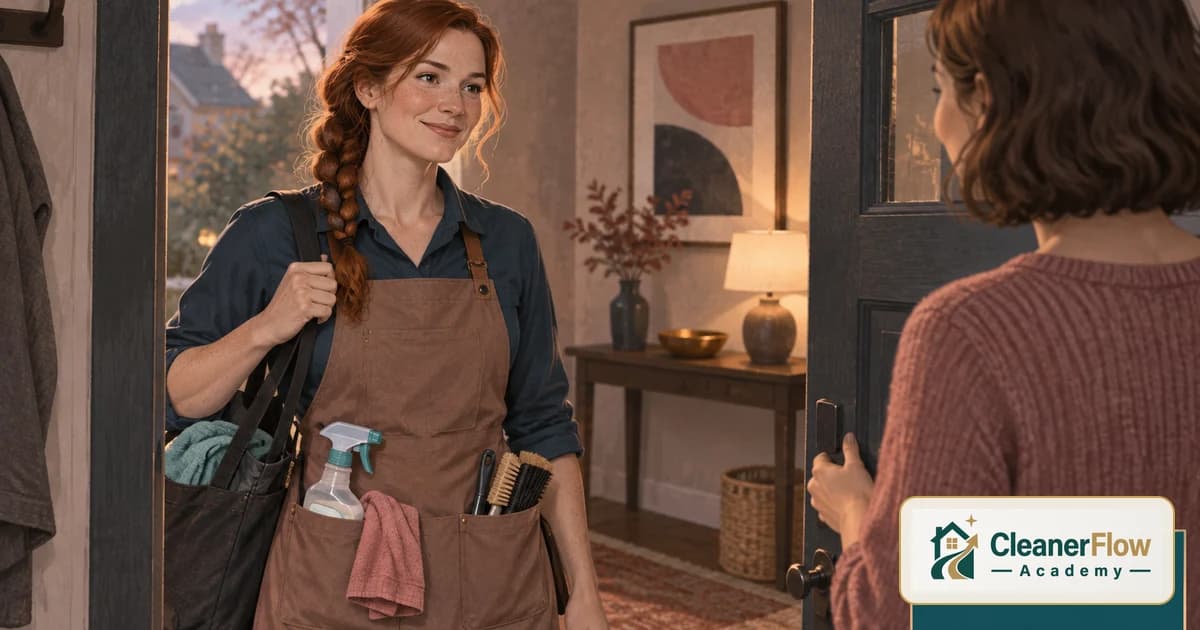
Trust is decided before the first floor is mopped
Here is something most house cleaners never fully realize. By the time a client watches you clean, they have already made most of their decision about whether they trust you. The judgment happens early, often in the first phone call, the first message, the first few minutes at the door. Everything after that mostly confirms or slightly adjusts a feeling that already formed.
That sounds unfair, and in a way it is. Your skill deserves to be judged on results. But clients are human, and humans decide trust using signals long before they have proof. The good news is that once you understand which signals they read, you can send the right ones on purpose. This article walks through how clients actually decide, and what you can do about each part.
What a client is really afraid of
To understand trust, start with the fear underneath it. When someone hires a house cleaner, they are not mainly worried about a missed corner. They are worried about bigger things:
- Will this person respect my home and my things?
- Will they take something, or go where they shouldn't?
- Will they actually show up, or leave me stranded?
- Will they do a real job, or a rushed one I have to redo?
- Is this person safe to have around my family?
Every signal a client reads is really them searching for answers to these questions. When you know that, you stop guessing and start addressing the real worry directly. Trust is not built by being impressive. It is built by quietly answering these fears before the client even has to ask.
Signal one: reliability in the small things
The very first test a client runs is whether you do what you say. If you say you will call at three, calling at three matters more than most people realize. If you agree to arrive at nine, arriving at nine, not nine fifteen, speaks volumes.
These small moments feel minor to you, but to the client they are a preview. Their logic is simple and reasonable: if this person keeps their word about a phone call, they will probably keep their word inside my home. If they are careless about time now, they may be careless with my things later.
So reliability is not a boring background trait. It is one of the loudest trust signals you send, and it starts before you ever pick up a cloth. Answer messages when you say you will. Arrive when you promised. Do what you agreed. Each kept promise is a deposit in the client's trust. And if something goes wrong, a delay in traffic, a sudden illness, telling the client early and honestly protects the trust far more than a silent no-show ever could. Handling a problem well can build more confidence than a day where nothing went wrong at all.
Signal two: how you present yourself
People read appearance quickly, whether we like it or not. This does not mean you need anything fancy. It means clean, tidy, and put-together. A neat appearance tells the client that you take care, and someone who takes care of themselves is more likely to take care of a home.
The same goes for your tools and your manner. Organized supplies signal an organized professional. A calm, respectful way of speaking signals someone who is steady and safe. You do not need to perform. You just need to look and act like the professional you are, because the client is reading all of it as clues about how you will treat their space.
This also covers the small courtesies at the door. Wiping your feet, asking where they would prefer you to leave your things, respecting a request to remove your shoes, all of it tells the client that you notice and respect their home the way they do. Those first thirty seconds at the entrance carry more weight than any single one of them realizes.
Signal three: how you talk about the work
When you speak about cleaning, clients listen for whether you actually know what you are doing. They cannot judge your skill directly yet, so they judge how you describe it. Someone who speaks clearly and specifically about how they work sounds like a professional. Someone vague sounds uncertain.
Being specific is easier than it sounds. Instead of saying "I do a good job," describe your approach: how you handle a kitchen versus a bathroom, what you always check before you consider a room finished, how you treat delicate surfaces. You are not bragging. You are showing the client that there is a real method behind your work, and a method is reassuring.
This is also where honesty builds trust faster than salesmanship. If a client asks about something and you are straight with them, including about what you will and will not do, they relax. People trust those who tell the truth plainly far more than those who promise everything. Overpromising actually lowers trust, because clients have been burned by it before and they can smell it.
Signal four: proof they can check
Here is where many cleaners have a hidden advantage they do not use. Almost everything above is a signal, an impression. But a client trusts a fact they can verify far more than a feeling. And most house cleaners cannot offer any fact at all. They can only ask to be believed.
A certification changes that. When you can say you are certified through CleanerFlow Academy, a trilingual certification for house cleaners in the United States, you hand the client something firmer than a good impression. And if that certification can be verified, for example by scanning a code that confirms it is real, you move from asking to be trusted to letting the client confirm it themselves. That shift is powerful, because a nervous client hates having to just hope. Giving them something real to check calms the biggest part of their fear.
Remember to describe it honestly. The certification confirms the professional standard you already hold. It is a private certificate issued by CleanerFlow, not a government license, and it does not promise the client anything beyond your professionalism. Described truthfully, it becomes exactly the kind of checkable fact that builds trust faster than words.
Signal five: references and reputation
Clients also trust what other people say about you. A recommendation from a friend or neighbor carries enormous weight, because it is proof from someone with nothing to sell. If you have happy clients, gently encouraging them to refer you is one of the strongest things you can do, since a referral arrives with trust already attached.
Even without referrals, your reputation is built one job at a time. Every client you treat well becomes a possible source of future trust for someone new. This is why the long game of simply being consistent and honest matters so much. Reputation is slow to build and fast to spend, so protect it in every single job.
A simple habit helps here: after a job that clearly went well, it is fine to let a happy client know you appreciate referrals. Most people are glad to help someone they trust, but they rarely think to do it unless you gently open the door. You are not being pushy. You are making it easy for good work to travel.
Signal six: consistency over time
The deepest trust is not won in the first visit. It is earned by being the same professional every time. A client who has never had to worry about you, not once, over many visits, reaches a level of trust that no first impression can match. They stop watching. They hand you a key. They recommend you without hesitation.
This is the trust that turns a client into a long-term client, and long-term clients are the foundation of a stable cleaning business. They are why consistency is not just about doing good work today. It is about becoming, in the client's mind, someone they never have to think twice about. That reputation for steadiness is worth more than any single perfect job.
What quietly breaks trust
Just as certain signals build trust, a few habits chip away at it, often without the cleaner realizing. Being aware of them is half the battle:
- Running late without a message. Even ten minutes of silence plants a small doubt. A quick heads-up erases it.
- Promising more than you can deliver. The gap between the promise and the result is where trust dies. Underpromise, then do a little more.
- Being vague when asked a direct question. Dodging a question reads as hiding something, even when you are just unsure. It is better to say you will find out.
- Treating a home casually. Moving things without asking, taking calls throughout, or seeming rushed all signal that you do not fully respect the space.
- Overstating a credential. Claiming a certification is something it is not, an official license or a government approval, backfires the moment a client checks. Accurate always beats impressive.
Put the signals to work
You do not need to fake anything here. Every signal a client reads for trust is something a genuine professional already has: reliability, a tidy presentation, clear honest talk, real proof, good references, and consistency over time. The work is simply to be deliberate about them instead of leaving them to chance.
Start with the one that gives you a fact instead of a feeling. Get certified through CleanerFlow Academy, so that when a client is silently asking whether they can trust you, you have something real to offer, not just a promise. Then back it up with reliability and consistency, visit after visit, until trust becomes the natural state of your client relationships.
And as your reputation grows, running like a real professional means more than proof of skill. It means a steady schedule, a reliable flow of new clients, and simple tools to keep it all organized, which is exactly the ecosystem of tools CleanerFlow is building for cleaners. But it all rests on the same foundation this article is about: earning trust on purpose, one honest signal at a time.
You already clean well. Now you can prove it.
The 7 modules are free. The certificate, with a QR your client checks on the spot, proves what you already know how to do.
Other CleanerFlow apps
Your whole week in one place.
Homes, notes for every client, and who already paid, on your phone — even offline.
Cleaning jobs in your ZIP. See the quality score before you pay.
Every lead goes to 3 cleaners at most, and you get 14 days to dispute a dud.