
How to Charge for Travel When the House Is Far
An hour in the car is an hour of work nobody pays for. How to calculate the real cost of distance and charge for it without losing the client.
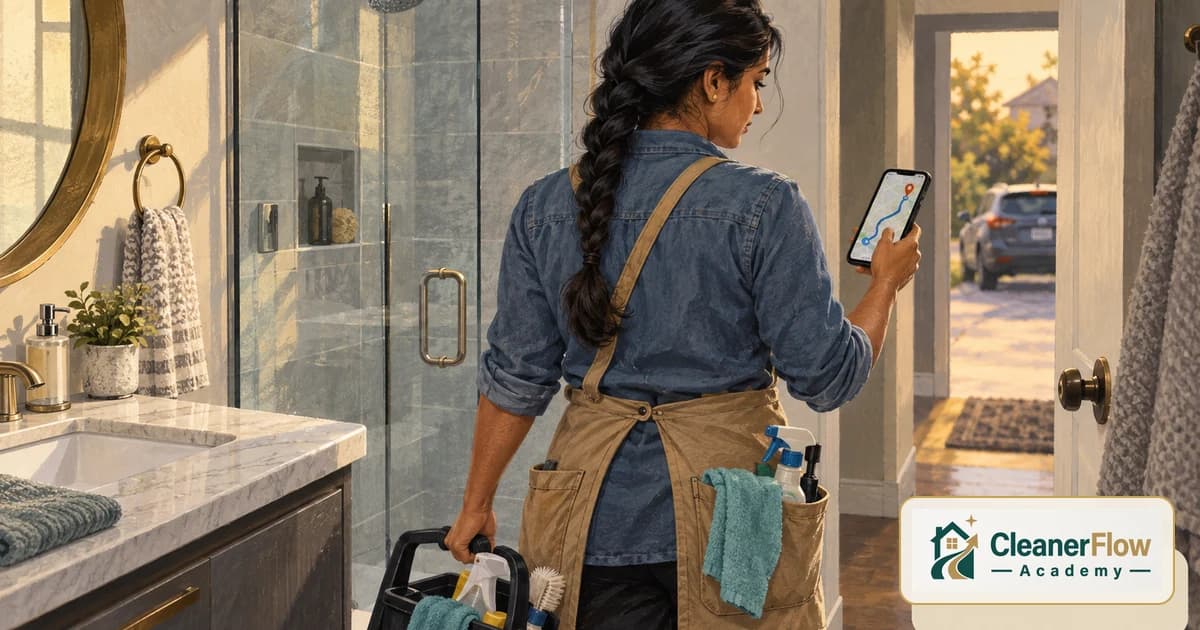
The Hour That Disappears From Your Math
You charge $140 for a house and spend three hours cleaning it. That looks like $46 an hour.
Except the house is 35 minutes away. There and back is over an hour in the car, plus fuel, plus wear on the vehicle. The real math is $140 for four hours and ten minutes, minus about $12 of gas: roughly $30 an hour.
Distance ate a third of your earnings, and it never appeared anywhere.
The Real Cost of One Trip
Three things, and the second is the one almost everyone forgets:
1. Fuel. Easy to feel, and the smallest of the three.
2. Wear on the car. Tires, brakes, oil, depreciation. That is precisely why the IRS standard mileage rate exists — it is meant to represent the total cost of driving a mile, not just the gas. Use the current year rate as your reference for what the trip actually costs.
3. Your time. The most expensive of the three. An hour in the car is an hour you are not cleaning, not quoting, and not resting. It is working time that nobody pays for.
The Radius Worth Serving
Before deciding what to charge, decide how far you go. Most well-organized professionals work like this:
- Up to 15 or 20 minutes: normal area, no fee
- 20 to 40 minutes: travel fee
- Over 40 minutes: only for a big job, a full day, or a recurring client who justifies it
Two houses 40 minutes apart on the same day is a day lost in traffic. Four houses inside a 15-minute radius is the same day earning far more.
Cluster by area. North side on Mondays, south side on Wednesdays. That is worth more money than a price increase.
Three Ways to Charge
1. A flat fee by band. The simplest to explain and the one that causes the least argument:
> Up to 20 min: no fee · 20 to 35 min: $15 · 35 to 50 min: $30
2. A different price by area. You never say "fee", you simply have a slightly higher price for the farther ZIPs. It avoids the whole conversation.
3. A higher minimum for far jobs. "Outside my area, my minimum is $180." This works well because it moves the conversation from fee to job size — and naturally filters out the small house that does not justify the drive.
How to Say It Without Sounding Greedy
The mistake is apologizing. State it as a fact, together with the price, without hesitating:
> "That ZIP is about 35 minutes from me, so there is a $20 travel fee. The cleaning itself is $140."
If the person pushes back, the good explanation is about time, not gas:
> "The drive is a little over an hour round trip. That is time I am not able to work, so I include it in the price."
Nobody argues with that, because everybody understands time.
When Going Far Without Charging Makes Sense
There are cases where the drive pays for itself:
- A big job. A $450 move-out absorbs the trip.
- A weekly recurring client. One fixed house out there can become an anchor you build the day around.
- An area you want to open. A first house in a good neighborhood, which usually becomes two or three by referral.
In those cases you are not giving up the fee — you are investing. The difference is that it is your decision, not an oversight.
The Detail That Gives Money Back at Tax Time
Every mile between one client and another is deductible. Every supply run is deductible. The trip you make to give a quote that does not close counts too.
Log date, miles, destination and reason. The part that usually does not count is home to your first client and last client back home — the rest counts.
So distance costs you money during the year and gives part of it back in April, provided somebody wrote it down.
The One-Line Calculation
Before accepting a far house, run this division:
price charged ÷ (cleaning hours + driving hours)
If the result falls below what you make at a nearby house, either the house pays more or you decline. It is not rudeness — it is arithmetic, and it is what separates working a lot from earning well.
You already clean well. Now you can prove it.
The 7 modules are free. The certificate, with a QR your client checks on the spot, proves what you already know how to do.
Other CleanerFlow apps
Your whole week in one place.
Homes, notes for every client, and who already paid, on your phone — even offline.
Cleaning jobs in your ZIP. See the quality score before you pay.
Every lead goes to 3 cleaners at most, and you get 14 days to dispute a dud.