How to Communicate With Clients Like a Pro
Great cleaning gets you hired once. Great communication keeps you hired for years. Here is how to talk to clients in a way that builds trust, prevents problems, and earns respect.
Communication is part of the job
Many cleaners believe the work speaks for itself. The floors shine, the counters gleam, and surely the client will notice. Sometimes they do. But the clients who stay with you for years, who recommend you to their friends, and who never argue about price are almost always the ones who feel they can talk to you easily. Communication is not separate from your skill. It is part of it.
Here is the good news: communicating like a professional is a skill you can sharpen, and it does not require perfect grammar or a big vocabulary. It requires being clear, being reliable, and being calm. Those three things are within reach for everyone, in any language.
When the CleanerFlow Academy certification validates you as a professional, it is validating the whole professional, not just the hands that clean. How you communicate is part of what makes you worth certifying, and part of what makes clients choose you over someone cheaper.
Your first impression sets the tone for everything
The way a client feels about you in the first five minutes shapes how they treat you for years. Before you have cleaned a single surface, they are already deciding whether you are a professional or just a pair of hands.
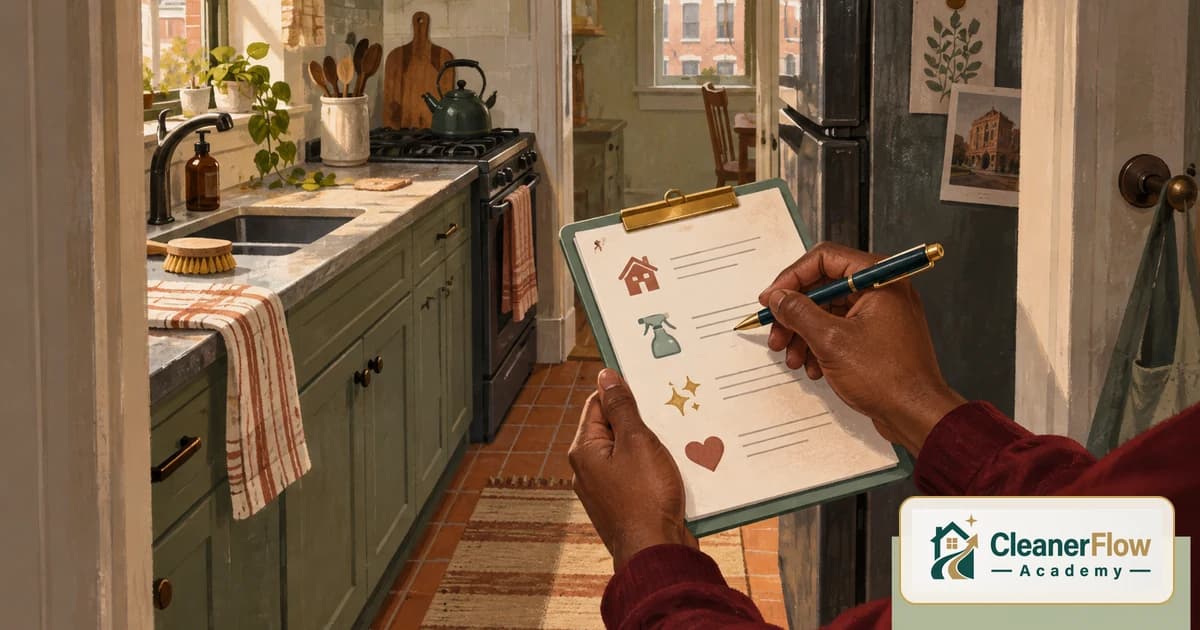
Small things carry enormous weight here. Arrive on time. Greet the person by name. Stand straight, make eye contact, and speak at a steady pace instead of rushing your words. If you carry a simple written list of what your service includes, showing it in that first meeting instantly signals that you run a real business.
Speak like someone whose service is worth paying for
Many skilled cleaners quietly undercut themselves with the words they choose. They say things like sorry to bother you, or I can do whatever you want, or is that okay with you about their own price. Notice the difference between I hope that's alright and here is what I recommend for a home this size. Both can be polite, but only one sounds like a professional. You are not asking permission to exist in someone's home. You are bringing a service they need.
Start every relationship with clear expectations
The best time to prevent a problem is before it happens. In your very first conversation with a new client, take a few minutes to set expectations out loud. What does your standard visit include? What time will you arrive? How long will it take? How do you prefer to be paid? When you say these things clearly at the start, you save both of you from a dozen small frustrations later.
Be specific about what is and is not included. A client who assumes that inside the oven and inside the windows are part of a standard visit, when they are not, will feel shortchanged even though you did nothing wrong. One clear sentence at the start prevents that entire conflict.
Questions that make you look thorough
Asking good questions is one of the fastest ways to look like a seasoned professional. Try working these into your first visit:
- Are there rooms or items you would rather I not touch?
- Do you have pets, and is there anything I should know about them?
- Are there products you prefer, or any surfaces that need special care?
- What is the one thing that, if I always get it right, would make you happy?
That last question is powerful. It tells you exactly where to aim, and it shows the client that their priorities matter to you. People feel respected when you ask about their home instead of assuming, and every answer you gather makes your work smoother.
Confirm before every visit
A short message the day before a visit is one of the simplest and most powerful habits you can build. A friendly note confirming you will be there tomorrow at the usual time is enough. It does three things at once. It reminds the client so they are not surprised. It gives them a chance to reschedule if something changed on their end. And it quietly shows that you are organized and dependable.
Most cancellations that catch you off guard could have been caught a day earlier with a simple confirmation. That one message protects your schedule and your income more than almost anything else you can do.
Staying on top of these confirmations across many clients is exactly the kind of thing a good scheduling tool makes easier. As your client list grows, keeping every appointment and reminder organized becomes real work, and it is one of the areas the CleanerFlow ecosystem is being built to support.
Talk about money without flinching
Nothing tests a cleaner's communication like money. Many talented people lose income simply because they get nervous the moment a price or a raise comes up. Their voice drops, they add unnecessary discounts, or they avoid the subject until resentment builds.
The fix is to treat money as a normal, calm part of the conversation, because that is exactly what it is. State your price clearly and then stop talking. Silence after a number is not rude; it is confident. If a client pushes back, you can hold your ground kindly: I understand, and this is the rate for the quality and reliability I bring.
A simple way to raise your rate
Raising your price with a long-time client feels scary, but it does not have to be a fight. Give notice, keep it short, and do not over-apologize. Something like this works well: starting next month my rate for your home will be the new amount. Thank you for being a wonderful client. I look forward to continuing. Notice there is no long defense and no guilt. You are informing, not begging. Most good clients accept a fair, well-communicated increase without drama.
Speak up early when something is wrong
Problems shrink when you talk about them early and grow when you hide them. If you accidentally break a small item, tell the client that same day. If you notice the home needs more time than the agreed price covers, raise it kindly before you resent the job. If you are running fifteen minutes late, send a message rather than leaving the client wondering.
This takes courage, especially when you worry about upsetting someone. But clients almost never lose trust over an honest, early heads-up. They lose trust when they discover something was hidden. Being the person who communicates bad news calmly and quickly is one of the strongest reputations you can build.
When you raise an issue, offer a solution alongside it. Instead of only saying the vacuum broke, say the vacuum broke, so today I focused on mopping and dusting, and I will bring a working vacuum next time. People relax when they see you are already handling it.
Handle feedback without taking it personally
One day a client will point out something they were not happy with. A missed corner, a streak on the glass, a room that needed more attention. It stings, especially when you worked hard. The professional response is not to defend yourself and not to over-apologize. It is to listen, thank them for telling you, and fix it.
Try a simple three-part reply. First, acknowledge: thank you for letting me know. Second, take responsibility without drama: you are right, I will take care of that. Third, act: fix it now if you can, or make sure it is perfect next time. This response turns a complaint into a moment that actually builds trust, because the client learns that when something is wrong, you make it right.
Remember that feedback is information, not an attack. A client who tells you what they want is giving you the exact instructions to keep them happy for years. The client to worry about is the one who says nothing and simply stops calling.
Keep the tone warm and professional
You can be friendly without becoming so casual that you lose respect. Greet clients warmly. Remember small details about their home and their family. Say thank you. At the same time, keep enough professional distance that money conversations, schedule changes, and boundaries stay easy to talk about. The goal is a relationship that is warm but clearly a working one.
Be careful with humor and opinions in someone else's home. Stay away from strong political or personal topics. You never know who you are talking to, and a neutral, respectful presence is always the safe choice. Your job is to make the client feel comfortable, not to make yourself the center of attention. It is also wise to keep gossip out of your work entirely. A cleaner who talks about one client's home to another teaches every client that their privacy is not safe with you.
When there is a language barrier
Plenty of excellent cleaners work in a language that is not their first. If that is you, do not let it shake your confidence. Clear beats fancy every time. Short sentences, simple words, and a calm tone communicate professionalism better than a large vocabulary delivered nervously.
A few practical habits help. Confirm important details in writing so nothing depends on catching every spoken word. Repeat back what you understood: so you would like the kitchen and two bathrooms, and you will be home at noon. Do not be afraid to ask someone to say it again. Asking for clarity is a sign of care, not weakness. And this is exactly why a trilingual certification matters: it lets you prove your professionalism in your own language while working in another.
Written messages matter as much as spoken ones
Many of your conversations with clients will happen by text message. Take a moment to make those messages clear and polite. A message that is warm and easy to read builds confidence. A message that is confusing or too blunt can create doubt, even when you meant well.
You do not need long paragraphs. Short, clear, kind messages work best. Confirm times clearly. Use the person's name. End with a simple thank you. And when a client sends you a message, try to reply within a reasonable time so they never feel ignored. It also helps to set a gentle boundary on hours; replying to a late-night message the next morning is perfectly professional. Reliability in small things is how clients decide you are reliable in big things.
Communication and dignity go together
There is a deeper reason to communicate well. Every clear, calm, respectful conversation you have pushes back against the old idea that cleaning is invisible work done by invisible people. When you speak like a professional who knows their value, you teach every client to see you that way. You are not just cleaning a home. You are raising the standard for how this entire profession is treated.
That dignity is at the heart of what CleanerFlow Academy stands for. The certification exists to recognize skilled cleaners as the professionals they are, and clear communication is one of the clearest signs of a professional at work.
Put it into practice, and get certified
Start small. Send a confirmation message before your next visit. Set clear expectations with your next new client. Reply to your next piece of feedback with the three-part approach. These habits compound. Over months and years, they turn one-time jobs into loyal clients and loyal clients into a full, steady schedule.
And when you are ready to prove your professionalism to the world, get certified with CleanerFlow Academy. It is free, it is available in English, Portuguese, and Spanish, and it validates the complete professional you already are: your hands, your standards, and the calm, clear way you talk to the people who trust you with their homes.
You already clean well. Now you can prove it.
The 7 modules are free. The certificate, with a QR your client checks on the spot, proves what you already know how to do.
Other CleanerFlow apps
Your whole week in one place.
Homes, notes for every client, and who already paid, on your phone — even offline.
Cleaning jobs in your ZIP. See the quality score before you pay.
Every lead goes to 3 cleaners at most, and you get 14 days to dispute a dud.