
How to Remove Pet Hair Fast in Any Home
Pet hair works its way into fabric, corners, and air. Here is a professional, room-by-room method to remove it quickly and leave a home that feels truly clean.
Why pet hair is harder than it looks
Pet hair is not just sitting on top of surfaces waiting to be swept away. It carries a light static charge, so it clings to upholstery, baseboards, and the sides of furniture. It also weaves itself into the fibers of rugs and couches, where a vacuum alone often glides right over it. If you have ever finished a home and still seen a fine layer of fur an hour later, it is usually because the hair was lifted into the air during cleaning and settled again after you left.
The goal of a professional is not only to remove the hair you can see, but to break the static bond, capture the loose fur before it becomes airborne, and work in an order that keeps you from re-contaminating rooms you already finished. That last point matters more than any single tool.
Build a simple pet-hair kit
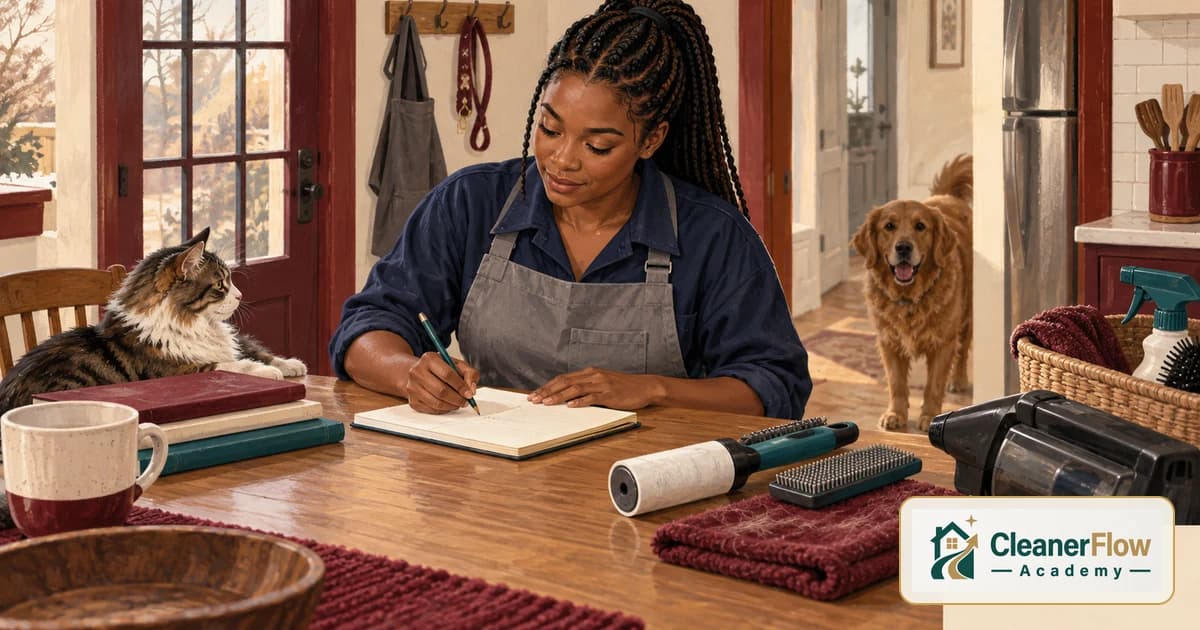
You do not need expensive gadgets to handle a shedding home well. A reliable kit costs very little and lives in your bag. Keep a pair of household rubber gloves used only for hair, a rubber squeegee, and a lint roller. For a big job, a wide roll of packing tape wrapped sticky-side-out around your hand covers far more area than a small roller and costs almost nothing. Add a few clean microfiber cloths, a vacuum with a motorized brush and a crevice tool, and a dry microfiber flat mop for hard floors. A rubber pet-hair brush earns its place on stubborn carpet.
The point is not to own every tool on the market. It is to always have the few that actually break the static bond and capture fur, so you never arrive at a fur-covered living room with only a broom and hope.
Work top to bottom and dry to wet
The single biggest time-saver is sequence. Always work from the highest surfaces down to the floor, and finish with any wet or damp step. Hair falls. If you vacuum the floor first and then dust a shelf, the hair from that shelf lands on the floor you just finished.
Start with elevated soft surfaces such as the tops of upholstered chairs, throw pillows, and blankets. Move down to seat cushions and sofa bases, then to hard furniture and baseboards, and only then to the floor. Save any damp wiping for the very end, because a damp cloth used too early will smear fine hair into a paste that is much harder to lift.
Break the static bond first
Before you reach for a vacuum, loosen the hair that is gripping the fabric. A slightly dampened rubber glove is one of the most effective tools a professional carries, and it costs almost nothing. Put on a household rubber glove, mist it very lightly with water, and drag your open hand across the cushion in one direction. The rubber creates friction that pulls embedded hair up into rolls you can pick up in seconds.
A rubber squeegee does the same thing on larger flat sections of a couch or a mattress. Pull it toward you in short, firm strokes and watch the hair gather at the edge. For pet beds and blankets, a quick tumble in a dryer on the air or no-heat setting for ten minutes, if the client permits, loosens an enormous amount of fur into the lint trap before you even begin.
Vacuuming that actually captures fur
A vacuum only helps if it has strong suction and a clean filter. Pet hair clogs filters fast, so check and empty the canister more often than you would in a home without animals. A full canister kills suction, and weak suction just pushes hair around.
Use a motorized brush roll or a rubber pet attachment on upholstery and rugs. The spinning brush agitates fibers and lifts hair the static bond was holding down. Go slowly. Passing the head over an area once at speed leaves most of the embedded hair behind. Instead, make several overlapping passes in different directions on the same spot. Hair lies flat in the direction the pet moved, so crossing your strokes catches what a single direction misses.
For edges, corners, and the seams of cushions, switch to the crevice tool. Fur collects exactly where two surfaces meet, and a wide floor head cannot reach those lines.
Different fur needs a different touch
Not all shedding behaves the same way, and reading the fur saves you time. Short, coarse dog hair works like tiny needles. It embeds point-first into upholstery and even woven fabric, so it resists a light pass and needs the rubber glove and slow, firm strokes to work it loose. Long, soft cat hair behaves differently. It lifts more easily but floats and mats, and it travels much farther through the air, so smooth movements matter even more.
The fabric color changes your approach too. On dark upholstery, light-colored fur shows every strand, and a client will spot a missed patch the instant they sit down, so give dark sofas an extra overlapping pass and a final lint-roll. On light fabric, dark hair disappears into seams and folds, so work the crevice tool carefully along every seam, edge, and fold where it hides. Matching your effort to the fur and the fabric is often the difference between good enough and genuinely clean.
A word on safety in pet homes
Homes with pets are homes where a nose is often close to the floor. Keep the air as clean as the surfaces. Never mix cleaning products together. Combinations such as bleach and ammonia release dangerous fumes, and an animal resting nearby breathes them first and lowest. Use one product at a time, open a window or run a fan to ventilate, and keep pets out of a room while a product is still wet on the surface.
When you are unsure about a surface or a product, remember that plain water on a microfiber cloth removes most fur without any chemical at all. The safest clean is often the simplest one, and it protects both the animal and you.
Hard floors need a different approach
Never start hard floors with a wet mop. On tile, wood, or laminate, a wet mop pushes fur into wet clumps that stick in corners and along baseboards. Instead, capture the dry hair first. A dry microfiber flat mop or an electrostatic dry sweeping cloth attracts and holds fine hair rather than pushing it into the air. Work in long straight lines toward a single collection point and lift the hair into a dustpan rather than sweeping it around.
A traditional broom is the wrong tool for pet hair on hard floors. The stiff bristles fling lightweight fur into the air and send it drifting onto surfaces you already cleaned. If you must use a broom, choose one with fine, dense bristles and sweep slowly.
Only after the floor is free of loose hair should you damp mop for the final finish.
The air matters too
Much of the fur you fight settles out of the air after you disturb it. If the home has a forced-air system, the client can help by running the fan and using a fresh filter, but you can also reduce airborne fur by keeping your movements smooth rather than sudden. Shaking a blanket hard sends a cloud of hair across the room. Instead, fold soft items inward to trap the hair, or take them outside to shake if the client allows.
When you dust, use a slightly damp or treated microfiber cloth rather than a dry feather duster. A dry duster scatters fur; a microfiber cloth holds it. Rinse or swap cloths often, because a hair-saturated cloth stops picking anything up and just redistributes it.
A quick room-by-room order
Walk into a heavy-shedding home with a plan. In the living room, start with pillows and blankets, then cushions with a glove or squeegee, then vacuum the sofa in overlapping passes, then the floor. In bedrooms, strip and handle bedding first, run the rubber glove over any upholstered headboard, then the floor. In the kitchen and bathrooms, focus on the base of cabinets and the corners where hair drifts and piles up.
Throughout, keep a lint roller in your apron for the fast finishing touches, such as a lampshade, a dining chair seat, or the client's own coat if it is hanging in the entry. These small visible spots are what a client notices first when they walk in.
Mistakes that make pet hair worse
Most fur problems come from a handful of habits that are easy to drop once you see them. Wet-mopping before you remove the dry hair glues fur into corners and doubles your work. A dry feather duster launches fur into the air, so it lands again minutes later on a surface you already cleaned. Vacuuming with a full canister or a brush roll wrapped in old hair just moves fur around instead of lifting it. Rushing a single fast pass, when the job needs several slow overlapping ones, leaves embedded hair behind every time. And shaking blankets or cushions indoors fills the room with the very fur you came to remove.
Each of these is simple to avoid once you know it, and avoiding them is often the whole difference between an amateur result and a professional one in a heavy-shedding home.
Small habits that keep it fast
Empty your vacuum before it looks full, clean the brush roll of wrapped hair between homes, and keep a spare pair of rubber gloves in your kit purely for hair removal. Rinse your microfiber cloths thoroughly and dry them well, because leftover fur baked into a cloth in the dryer is nearly impossible to get out.
The difference between an amateur result and a professional one is rarely a special machine. It is the order of work, the patience to make overlapping passes, and the habit of breaking the static bond before you vacuum. Master those three things and you can leave even the heaviest-shedding home looking effortlessly clean.
Building a reputation for handling difficult homes well is exactly the kind of skill that a certification like CleanerFlow Academy is designed to recognize. Clients trust professionals who can walk into a fur-covered living room and leave it spotless, and that trust is what turns a single job into a steady client. You already have that skill; proving it with the certificate costs US$19.99 a year.
The finish check
Before you leave, run your bare hand across one cushion and one section of floor. If your palm comes away with fur, the surface needs another pass. This ten-second check catches the spots that will otherwise reappear as complaints. A home that passes the hand test will still look clean an hour later, when the client walks in and decides whether to book you again.
You already clean well. Now you can prove it.
The 7 modules are free. The certificate, with a QR your client checks on the spot, proves what you already know how to do.
Other CleanerFlow apps
Your whole week in one place.
Homes, notes for every client, and who already paid, on your phone — even offline.
Cleaning jobs in your ZIP. See the quality score before you pay.
Every lead goes to 3 cleaners at most, and you get 14 days to dispute a dud.