Certification vs. License: What's the Difference for House Cleaners
Certification and license sound alike, but they solve different problems. Here is what each one really means for a house cleaner in the United States, and how to decide which you actually need.
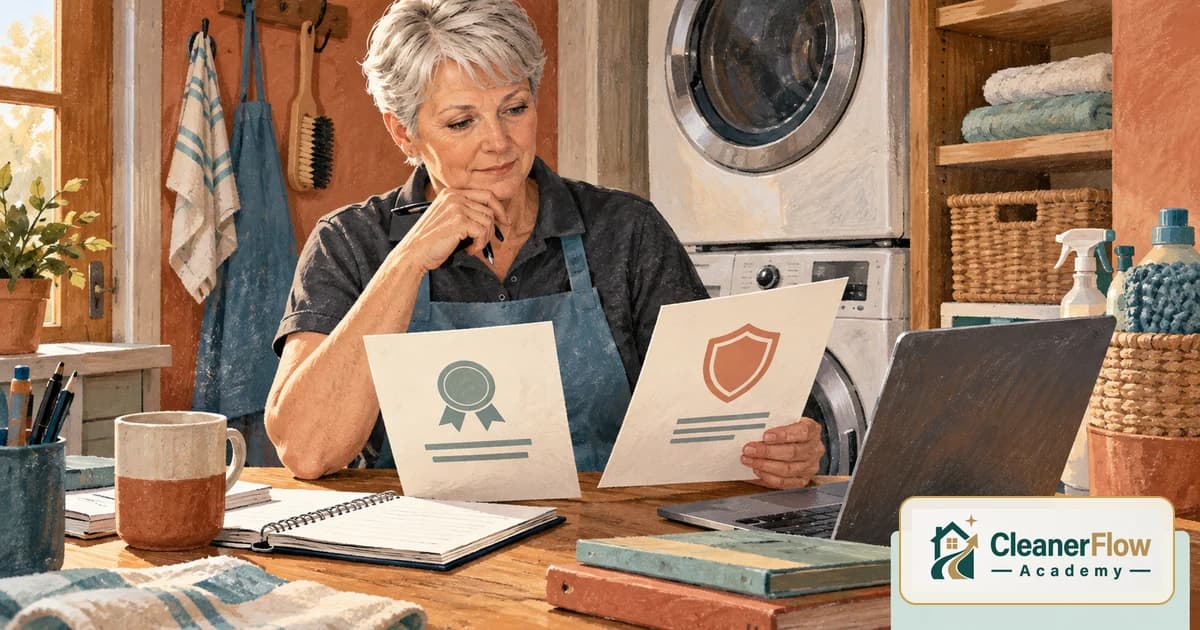
Two words people mix up every day
If you clean homes for a living, you have probably heard both words tossed around: certification and license. A client asks if you are licensed. A Facebook group tells you to get certified. A competitor puts "licensed and certified" on their van. It is easy to assume they mean the same thing, or that one is just a fancier version of the other.
They are not the same. They come from different places, they prove different things, and they solve different problems. Understanding the difference will save you money, keep you out of trouble, and help you talk to clients with confidence instead of guessing.
Let us walk through it in plain language.
What a license actually is
A license is permission from the government to do something that would otherwise be against the rules. It is issued by a public authority, usually a city, county, or state office. When you hold a license, a government body is saying, "We know you exist, you have met our requirements, and you are allowed to operate here."
Here is the part that surprises many cleaners: there is no federal license to clean houses in the United States. The federal government does not license house cleaners the way it licenses, say, airline pilots. Cleaning a private home is not a federally regulated profession.
So when someone says "you need a license to clean houses," what they usually mean is one of these local things:
- A general business license. Many cities and counties require anyone running a business, including a solo cleaner, to register and pay a small yearly fee. This is not about cleaning skill. It is about being a registered business in that place.
- A business tax registration or seller's permit. Some areas want you registered for local taxes.
- A DBA ("doing business as") registration. If you work under a name that is not your legal name, some counties ask you to record it.
Notice what none of these test: they do not test whether you know how to clean. A business license does not check if you can remove hard-water stains or handle a client's marble countertop safely. It only confirms you are a registered, taxpaying business in that jurisdiction.
Requirements vary a lot from place to place. A cleaner in one city might need to register and pay forty or fifty dollars a year. A cleaner one county over might need nothing at all. This is exactly why you cannot rely on what a friend in another state tells you. You have to check your own city and county.
How to find out what your area requires
- Search for your city or county name plus "business license" on the official government website. Look for a site that ends in .gov.
- Call or visit your city clerk or county clerk office. They deal with this every day and can tell you in five minutes.
- Ask a local tax preparer who works with small businesses.
Do not guess, and do not assume you are fine because no one has stopped you. Operating without a required local license can bring fines, and it looks bad if a client ever asks for proof.
What a certification actually is
A certification is a private credential. It is proof that you learned a body of knowledge and met a standard set by an organization, a school, or a training program. It is not the government giving you permission. It is a respected group saying, "This person went through our training and passed."
Think of the difference this way. A license is the government letting you open your doors. A certification is proof of what you know once those doors are open.
Certifications in the cleaning world can cover things like:
- Safe handling of cleaning chemicals and why you never mix certain products
- How to protect different surfaces, from granite to hardwood to stainless steel
- Room-by-room cleaning methods that are efficient and thorough
- Sanitizing and disinfecting the right way, especially in kitchens and bathrooms
- Professional conduct in a client's home, including trust, privacy, and communication
A certification does not give you legal permission to run a business. If your city requires a business license, a certification will not replace it. They live in different worlds. But a certification does something a license never will: it proves you actually know your craft.
This is where CleanerFlow Academy fits in. It is a mobile certification built specifically for residential house cleaners in the United States, and it works in English, Portuguese, and Spanish. It is a private certification, not a government license, and it is honest about that. The point is to give you real knowledge and a credential you can show, at no cost.
Why the difference matters in real life
Let us make this practical, because the distinction is not just academic. It changes how you run your work.
When a client asks "Are you licensed?"
Many clients ask this without knowing exactly what they mean. Often they are really asking three things at once: Are you a real business? Are you insured if something breaks? Do you know what you are doing?
A confident, honest answer sounds like this: "Yes, I am registered as a business in the county, I carry liability insurance, and I am certified in professional cleaning methods." Notice you separated the three ideas. You did not pretend a certification is a government license, and you did not pretend a business license proves your skill. You told the truth, and the truth sounds professional.
If you are not yet registered or insured, do not lie. Say what is true today and what you are working on. Clients respect honesty far more than a vague "yeah, I'm licensed" that falls apart under one follow-up question.
When you want to charge more
Skill is what lets you raise your rates without losing clients. A business license does not make anyone pay you more, because every registered cleaner has one and it says nothing about quality. A certification is different. It gives a client a reason to believe you are worth the higher price, because it shows you invested in learning the work properly.
When you are compared to a competitor
Imagine two cleaners quoting the same house. One says, "I clean houses." The other says, "I am certified in professional residential cleaning, I know how to protect your surfaces, and here is proof." Same house, same day. The second cleaner has given the client a reason to choose them and to feel safe. That reason is proof of skill, and that is exactly what a certification provides.
The insurance piece people forget
There is a third thing that often gets lumped in with license and certification, and it deserves its own moment: insurance, especially liability insurance and bonding.
Insurance is not a license and it is not a certification. It is a financial protection you buy. Liability insurance helps cover damage or injury that happens while you work. A bond is a form of protection that can reassure a client if something is stolen or goes wrong.
When clients say "licensed, bonded, and insured," they are naming three separate things:
- Licensed usually means registered as a legal business locally.
- Bonded means there is a bond in place for the client's peace of mind.
- Insured means you carry insurance to cover accidents and damage.
Certification is not in that phrase, but it belongs right next to it. Together, a business registration, insurance, and a real certification make you look and act like a professional, not a stranger with a bucket.
A simple way to remember all of this
- License = government permission. Local, not federal. Proves you are a registered business. Says nothing about your cleaning skill. Check your own city and county.
- Certification = proof of skill. Private, from a school or program. Proves what you know. Does not replace a license.
- Insurance and bonding = financial protection. Separate again. Protects you and the client if something goes wrong.
You may need all three. They do not cancel each other out, and none of them is optional in the sense that clients notice their absence.
What to do this week
If you want to get your footing in order, here is a calm, doable path.
- Find out whether your city or county requires a general business license, and if so, register. It is usually quick and inexpensive.
- Look into basic liability insurance for cleaners. Get a quote or two so you know the real cost in your area.
- Earn a certification that proves your skill so you can answer the "do you know what you're doing" question with proof instead of a promise. CleanerFlow Academy offers this free, in your language, from your phone.
None of this makes you rich overnight, and no honest article should promise that. What it does is make you legitimate, prepared, and easy to trust. In a business built on letting a stranger into someone's home, trust is the whole game.
The bottom line
A license and a certification are not competing versions of the same thing. One is the government's permission to operate. The other is proof that you are genuinely good at the work. Smart cleaners stop treating them as interchangeable and start collecting both, along with insurance, so that when a client asks a hard question, the honest answer is also an impressive one.
Know the difference, tell the truth, and let your proof of skill do the talking.
You already clean well. Now you can prove it.
The 7 modules are free. The certificate, with a QR your client checks on the spot, proves what you already know how to do.
Other CleanerFlow apps
Your whole week in one place.
Homes, notes for every client, and who already paid, on your phone — even offline.
Cleaning jobs in your ZIP. See the quality score before you pay.
Every lead goes to 3 cleaners at most, and you get 14 days to dispute a dud.