How to Prove You're a Professional Cleaner to a New Client
A new client can't see the years of work behind you. Here are the simple, practical ways to show anyone that you clean like a professional, from before-and-after photos to references, insurance, and a credential that qualifies your experience.
Why a New Client Needs Proof
When someone lets you into their home for the first time, they are trusting you with more than a set of keys. They are trusting you with their children's bedrooms, their private spaces, their belongings, and their sense of safety. That is a big thing to ask of a stranger. So it is completely fair that a new client wants some proof before they hand you that trust.
Here is the hard part. You may already have five, ten, or twenty years of real cleaning experience. You may know exactly how to bring a grimy shower back to life or how to make hardwood floors shine without leaving streaks. But a new client cannot see any of that. They only see a person they have never met. Your job, in those first conversations, is to make your experience visible to someone who has no way of knowing it yet.
The good news is that proving you are a professional is not about big words or expensive certifications. It is about a handful of simple, honest things you can start doing this week. Let's walk through them one by one.
Build a Simple Portfolio With Before-and-After Photos
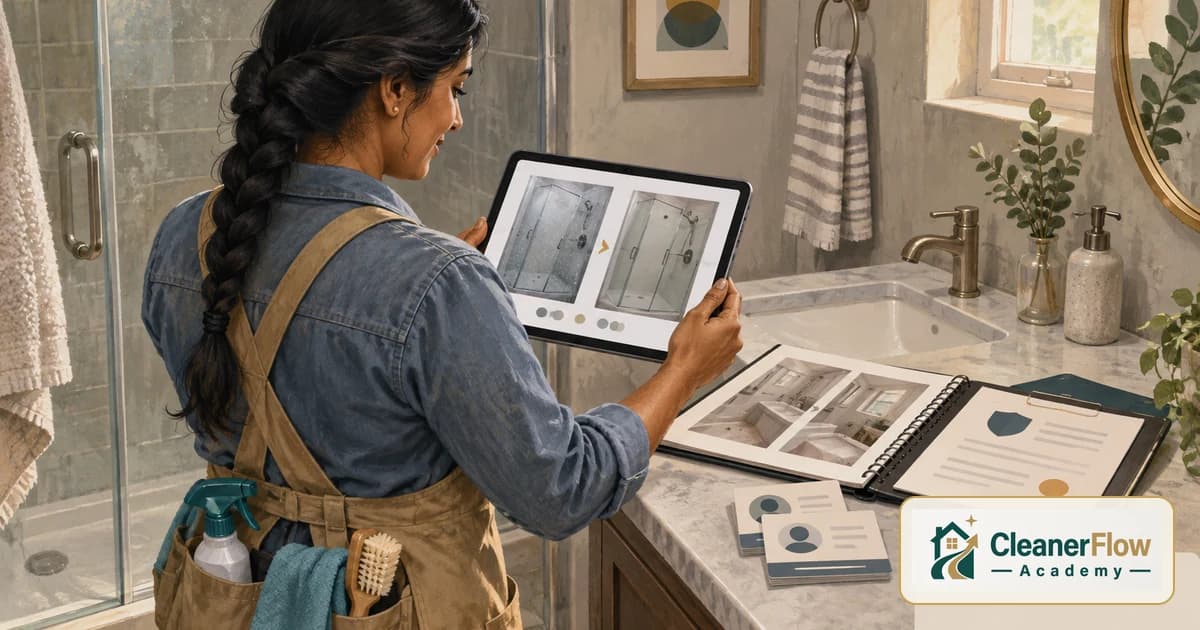
Nothing speaks louder than a photo of your own work. A before-and-after picture shows a client exactly what you can do, without you having to say a single word about it.
You do not need a fancy camera. The phone in your pocket is enough. The habit to build is this: before you start a job, take a quick photo of the areas that will change the most. A greasy stovetop, a soap-stained shower door, a cluttered kitchen counter, a dusty set of blinds. When you finish, stand in the exact same spot and take the after photo from the same angle. That matching angle is what makes the difference feel real.
A few tips that make your photos look professional:
- Turn on the lights or open the curtains. Good light makes clean surfaces sparkle and hides nothing.
- Wipe the lens. A smudged phone camera makes everything look foggy.
- Keep the frame steady and shoot from the same height and distance for both photos.
- Get permission first. Always ask the client if it is okay to photograph their space, and never include faces, personal documents, family pictures, or anything that identifies where they live.
Over time, collect ten or fifteen of your best pairs in a folder on your phone or in a free photo album app. When a new client asks what you can do, you simply show them. A shower that went from cloudy to crystal clear says more than any promise.
Collect References and Reviews
A reference is a real person who can vouch for you. A review is that same trust written down where new clients can read it. Both answer the quiet question every new client is asking: Can I believe what this person is telling me?
Start with the clients you already have. When you finish a job and the client seems happy, that is the moment to ask. Keep it simple and warm:
- "I'm so glad you're happy with the work. Would you mind if I gave your name to a new client who wants to ask about me?"
- "If you have a minute, a short review online really helps me. It means a lot."
Most happy clients are glad to help, but many will not think to do it unless you ask. Make it easy for them. If they agree to leave an online review, send them the exact link so all they have to do is tap and type. If they prefer to be a phone reference, ask permission first and keep a short list of two or three people a new client can call.
When you have written reviews, save screenshots of them. You can show them on your phone during a first meeting, the same way you show your photos. Three honest sentences from a real client such as "She is on time, she is careful, and my house has never been cleaner" can close a deal on its own.
Show Up With a Checklist and a Clear Scope of Work
Amateurs guess. Professionals have a plan. One of the fastest ways to look like a professional is to walk in with a written checklist of what you will clean.
A scope of work is simply a clear list of what is included in the job and what is not. It protects both you and the client. The client knows exactly what they are paying for, and you never get blamed for something that was never part of the agreement.
Your checklist might be organized room by room. For a bathroom, for example:
- Scrub and disinfect the toilet, inside and out
- Clean and shine the mirror and sink
- Wash the shower and tub, including glass and tile
- Wipe down counters and cabinet fronts
- Sweep and mop the floor
- Empty the trash and replace the liner
When you hand a new client a printed or digital checklist during your first visit, two things happen. First, they see that you take your work seriously. Second, they relax, because they finally know what to expect. You can also use the same checklist at the end of each job to double-check your own work before you leave. Nothing gets forgotten, and your quality stays the same every single time.
If a client wants something outside the standard list, such as cleaning inside the oven or washing interior windows, you can offer it as an add-on with its own price. That is exactly how a professional handles it.
Understand Insurance and Bonding, Explained Plainly
These two words sound complicated, but the idea behind them is simple, and being able to explain them calmly makes you look far more professional than most.
Liability insurance protects the client if something goes wrong on the job. Say you accidentally knock over an expensive vase, or a cleaning product damages a countertop. Insurance is what pays to fix or replace it, instead of the cost coming out of your own pocket or ending in an argument. Clients feel much safer knowing that if an accident happens, it is covered.
Being bonded is a form of protection that covers the client in the case of theft. If a cleaner were ever accused of taking something, a bond is the money set aside to make it right. For a client letting a new person into their home, that word "bonded" is a real comfort.
You do not have to become an expert overnight. In the United States you can call a local insurance agent and ask about a general liability policy for a house cleaning business, and often about a bond as well. Policies for small cleaners are usually more affordable than people expect. Once you have coverage, you can say the simple, powerful sentence: "I'm insured, so you're protected if anything ever goes wrong." If you are not insured yet, be honest about it. Never claim coverage you do not have, because that is the kind of promise that destroys trust the moment it is tested.
Communicate Clearly and Give a Written Quote
The way you talk with a client before the first job tells them a lot about the way you will work. Clear, calm, prompt communication is one of the strongest professional signals there is.
Answer messages within a reasonable time, even if it is only to say you will reply properly later. Use complete, polite sentences. Confirm the date and time in writing so there is no confusion. When a client sees that you are organized in a text message, they trust that you will be organized in their home.
The quote is where this really matters. A professional does not throw out a random number over the phone. Instead:
- Ask about the size of the home, the number of bathrooms, and whether there are pets.
- Ask what kind of cleaning they want, whether it is a first deep clean or regular upkeep.
- Whenever possible, offer to visit and see the space before quoting.
- Then put your price in writing, clearly stating what is included.
A written quote might simply say: "Standard cleaning of a two-bedroom, one-bathroom apartment, including all rooms on the checklist, for a set price. First deep clean priced separately." When the price is written down and tied to a clear scope, there are no uncomfortable surprises later. That clarity is exactly what separates a professional from someone just looking for quick cash.
Be Punctual and Reliable
Of all the ways to prove you are a professional, this one costs nothing and matters most: show up when you said you would.
A client planning their day around your visit is trusting your word. Arriving on time, every time, tells them their time matters to you. If you are ever running late because of traffic or an earlier job, a short message makes all the difference: "I'm running about fifteen minutes behind, I'll be there by ten fifteen. Thank you for your patience." That one text turns a possible frustration into another reason to trust you.
Reliability is bigger than a single visit. It is keeping the schedule you agreed to week after week. It is finishing what you promised. It is being the person a client never has to worry about. Over months, this steadiness becomes your strongest advertisement, because reliable people get recommended to friends and family without ever being asked.
Present Yourself Like a Professional
Before you clean a single surface, a client is already forming an impression of you. Your presentation is part of your proof.
This does not mean anything expensive or fancy. It means:
- Clean, tidy clothes that you can move and work in. Some cleaners wear a simple matching shirt or apron, which looks organized and put-together.
- Neat, well-kept supplies. Cleaning tools that are themselves clean send a quiet message about how you work.
- A calm, friendly manner. Make eye contact, greet people warmly, and speak with confidence about what you do.
- Respect for the home. Small habits like wiping your feet, asking where to leave your shoes, and handling belongings gently all show care.
Professionalism is really just visible respect: respect for the client, for their home, and for your own craft. When someone sees that respect in how you carry yourself, they believe it in how you clean.
Hold a Credential That Qualifies Your Experience
There is one more piece that ties all of this together, and it is one many cleaners overlook. You can hold a credential that puts your experience in writing.
Here is an honest fact worth knowing. In the United States there is no single federal license required to clean houses, and no government cleaning license that everyone must carry. So when a client asks whether you are "certified," the truth is that no official national certificate is legally required. But that does not mean a credential has no value. A recognized certificate gives a client something concrete to point to, a sign that you take your profession seriously and that your skills have been formally acknowledged.
This is where CleanerFlow Academy can help. It is a trilingual certificate, available in English, Portuguese, and Spanish, created to qualify the experience you already have as a residential house cleaner. It is not a course that treats you like a beginner and not a government license, but rather a private credential that recognizes and formalizes the real skills you have built over years of work. You earn it in your own language, and you can show it to a new client alongside your photos and your references as one more clear reason to trust you.
A credential like this is powerful precisely because it makes the invisible visible. Your years of experience finally have a name a client can see and understand.
Putting It All Together
Proving you are a professional is not one grand gesture. It is a collection of small, honest signals that add up to trust:
- A folder of before-and-after photos that show your real work.
- References and written reviews from clients who are glad they hired you.
- A checklist and clear scope of work that leaves nothing to guesswork.
- Insurance and bonding that protect the client, explained in plain words.
- Clear communication and a written quote that hold no surprises.
- Punctuality and reliability that never let a client down.
- A tidy, respectful presentation from the moment you arrive.
- A credential that qualifies the experience you already have.
You do not need all of these on day one. Pick one this week and start. Take a before-and-after photo on your next job. Ask one happy client for a reference. Write out your checklist. Each small step makes your experience a little more visible, and a little easier for a new client to trust. The skill has always been in your hands. Now you are simply learning to show it.
You already clean well. Now you can prove it.
The 7 modules are free. The certificate, with a QR your client checks on the spot, proves what you already know how to do.
Other CleanerFlow apps
Your whole week in one place.
Homes, notes for every client, and who already paid, on your phone — even offline.
Cleaning jobs in your ZIP. See the quality score before you pay.
Every lead goes to 3 cleaners at most, and you get 14 days to dispute a dud.