The Cleaning Chemicals You Should Never Mix
 Academy Team November 23, 2026 11 min read
Some common cleaning products become dangerous the moment they are combined. Knowing which pairs to keep apart is a basic safety skill every house cleaner needs. Here are the mixtures to avoid and why.
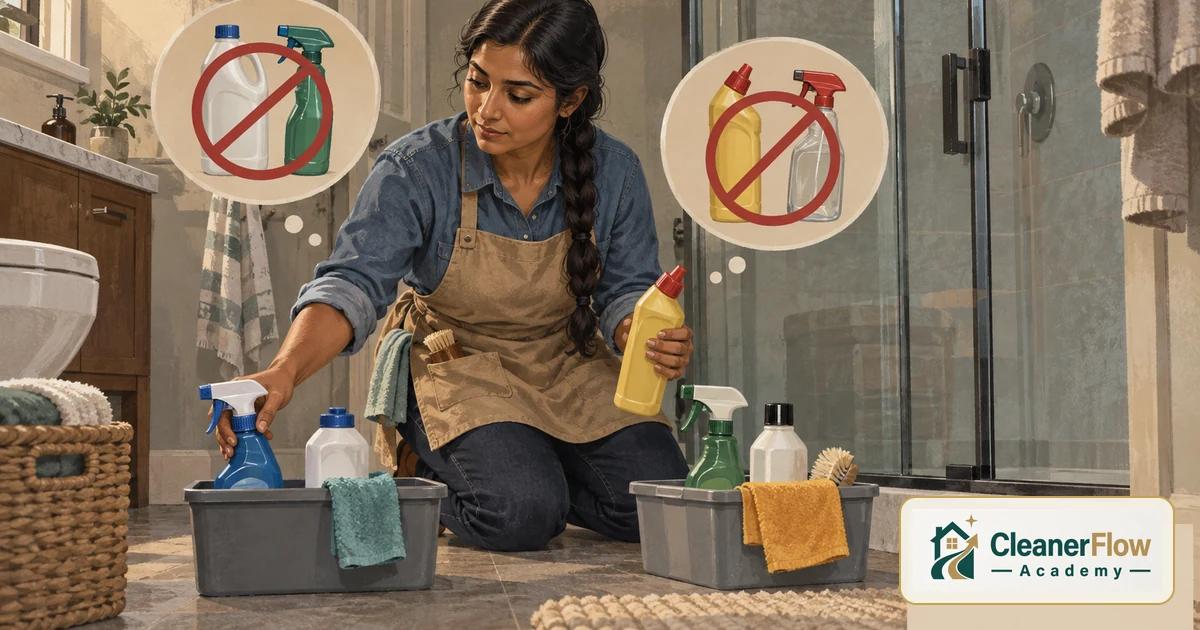
A safety skill every cleaner needs
Most cleaning products are safe when used as intended. The danger appears when two products meet, either mixed on purpose to make something stronger, or combined by accident on the same surface. Certain everyday cleaners react with each other to release toxic gases that can burn your eyes, damage your lungs, and in poorly ventilated spaces cause serious harm. This is not a rare hazard. It happens in ordinary homes, with ordinary products, to people who simply did not know.
This article covers the specific combinations to never mix, why each is dangerous, and the safe habits that keep you protected on every job. Treat this as core knowledge, not optional. Understanding it protects you, the people whose homes you clean, and your reputation as a professional who works safely.
Why mixing feels tempting
The instinct to combine products comes from a reasonable-sounding but false idea: if one cleaner is strong, two together must be stronger. In reality, mixing usually does not improve cleaning power, and it can create a chemical reaction that produces something entirely different from either original product, often a harmful gas. The strength you are reaching for does not come from combination. It comes from using the right product correctly, with enough dwell time and the right technique.
There is also the accidental case, which is more common than the deliberate one. You use one product on a surface, then reach for another before the first is rinsed away, and the two react without you intending it. Knowing the dangerous pairs protects you from both the mistake of mixing and the mistake of layering.
The combinations to never mix
These are the pairings every cleaner must know. Commit them to memory.
Bleach and ammonia
This is the most important pair to know. Bleach mixed with ammonia produces toxic gases that attack the eyes, nose, throat, and lungs. The danger is amplified because ammonia is present in many products people do not think of as ammonia, including some glass cleaners and some multi-surface sprays. Always read labels. If a product contains ammonia, it must never meet bleach, whether mixed in a bucket or applied to a surface still wet with the other.
Bleach and acids
Bleach combined with an acid releases chlorine gas, which is highly toxic and was historically used as a chemical weapon. Acids are common in cleaning: many toilet bowl cleaners, many rust and lime removers, and vinegar are all acidic. Never mix bleach with vinegar, never mix bleach with an acidic toilet cleaner, and never use bleach on a surface where an acidic product still remains. This combination can happen easily in a bathroom, where both bleach-based and acid-based products are often used, so be especially careful there.
Bleach and rubbing alcohol
Bleach mixed with rubbing alcohol can create chloroform and other harmful compounds. Both products are common in a cleaning kit, so keep them well separated and never apply one over the other.
Two different drain or oven cleaners
Heavy-duty drain and oven cleaners are among the strongest products in any kit, and mixing two different ones, or using one after another without thorough rinsing, can cause violent reactions. Never combine strong specialty cleaners. Use one, rinse completely, and ventilate before considering another approach.
Hydrogen peroxide and vinegar
Combining hydrogen peroxide and vinegar in the same container creates peracetic acid, which can irritate the skin, eyes, and lungs. Using them on a surface one after another, with rinsing in between, is different from mixing them together in a bottle, which should be avoided.
Different products in the same reused bottle
A quiet source of accidental mixing is refilling a spray bottle with a different product than it held before, without fully rinsing it. Residue of the old product can react with the new one. Never assume a bottle is empty of its previous contents, and label your bottles clearly so you always know what is inside.
The habits that keep you safe
Knowing the dangerous pairs is the foundation. These habits turn that knowledge into consistent protection on every job.
Read every label before you use a product
Labels tell you what is inside and what not to combine it with. Manufacturers print specific warnings about mixing precisely because these dangers are real. Make reading the label a habit with any product you are not completely sure about, especially in a client's home where you may encounter products you did not bring.
Use one product at a time and rinse between
The simplest rule that prevents accidental reactions is to finish with one product, rinse the surface thoroughly, and only then move to another. Most accidental mixing happens when a second product is applied over a first that has not been cleared away. Rinsing between products removes that risk almost entirely.
Never mix products to make them stronger
Resist the idea that combining cleaners boosts their power. It usually does not, and the risk is severe. If a product is not strong enough for a task, the answer is the correct product used correctly, with adequate dwell time, not a homemade mixture.
Ventilate the space
Open windows, run fans, and keep air moving whenever you use strong products. Ventilation reduces the concentration of any fumes and is a critical protection if an accidental reaction ever occurs. A well-ventilated room is far safer than a sealed one.
Keep your products organized and labeled
An organized kit prevents mistakes. Keep bleach-based and acid-based products stored separately, label every bottle clearly, and never transfer a product into an unlabeled or previously-used container without fully rinsing and relabeling it. Organization is not just tidiness. It is a safety system.
Wear protection for strong products
Gloves protect your skin, and eye protection matters when working with strong or splashing products. Basic protective habits reduce the harm from both normal use and any unexpected reaction. Caring for your own health is part of working professionally.
What to do if an accidental mix happens
Even careful people can make a mistake. If you ever mix products by accident and notice fumes, a strong smell, or any irritation, act immediately. Leave the area at once and get to fresh air. Do not stay to try to clean it up or to see how bad it is. Ventilate the space by opening windows and doors from a safe position if you can do so without breathing the fumes. If you experience difficulty breathing, burning in your throat or lungs, or other serious symptoms, seek medical help without delay and be ready to say which products were involved. Your health comes before any cleaning task, always.
Working in homes you did not stock
A particular risk for house cleaners is using products a client already owns, which you did not choose and may not know well. A client may have several products under a sink, and you cannot assume any of them are compatible with each other or with what you brought. When using a client's products, read every label, use them one at a time with rinsing between, and never combine an unfamiliar product with anything else. When in doubt, use your own products that you know, or ask the client what a product is before using it.
Why this reflects professionalism
Working safely with chemicals is a mark of a real professional. Clients trust you in their homes, around their families and pets, and handling products responsibly is part of earning that trust. A cleaner who understands chemical safety protects everyone in the home, not just themselves. Professionals who take their craft seriously, whether through experience or a recognized standard such as a CleanerFlow Academy certification, treat this knowledge as fundamental, because doing excellent work means doing it safely.
A simple rule to remember them all
Memorizing every dangerous pair can feel like a lot, so hold onto one rule that covers most of the risk: keep bleach away from everything else. Bleach is the common thread in the most dangerous reactions, whether combined with ammonia, with acids like vinegar and toilet cleaner, or with rubbing alcohol. If you treat bleach as a product that works alone, applied to a clean, rinsed surface and never layered with or followed by anything, you avoid the majority of serious mixing accidents in home cleaning.
Build the same care around the other strong specialty products, the heavy drain and oven cleaners, treating each as a solo act that gets full rinsing and ventilation before anything else touches the surface. Most household cleaning does not need these powerful products at all, and using them sparingly and separately keeps you far from harm. When you do reach for something strong, slow down, read the label, clear the surface, open a window, and use it on its own. That deliberate pace is not wasted time. It is the habit that keeps a routine job from becoming an emergency.
The bottom line
Some common cleaning products become dangerous the instant they are combined. Never mix bleach with ammonia, with any acid including vinegar and acidic toilet cleaners, or with rubbing alcohol. Never combine two strong specialty cleaners, never mix hydrogen peroxide and vinegar in a bottle, and never reuse a bottle without fully rinsing it. Protect yourself by reading every label, using one product at a time with rinsing between, ventilating the space, keeping your kit organized and labeled, and wearing protection with strong products. If an accidental mix ever produces fumes, leave for fresh air immediately and seek help if you feel unwell. This knowledge is not optional. It is the foundation of working safely, and it protects you, the homes you serve, and your standing as a professional.
This week's post, in your inbox
One email a week, every Tuesday, with the new post from the blog.
You already clean well. Now you can prove it.
The 7 modules are free. The certificate, with a QR your client checks on the spot, proves what you already know how to do.
Other CleanerFlow apps
Your whole week in one place.
Homes, notes for every client, and who already paid, on your phone — even offline.
Cleaning jobs in your ZIP. See the quality score before you pay.
Every lead goes to 3 cleaners at most, and you get 14 days to dispute a dud.